"This site requires JavaScript to work correctly"

Welcome to dit

everything you need to know about your studies at dit

students.

overview of all essential information

start your studies


New university app available now!

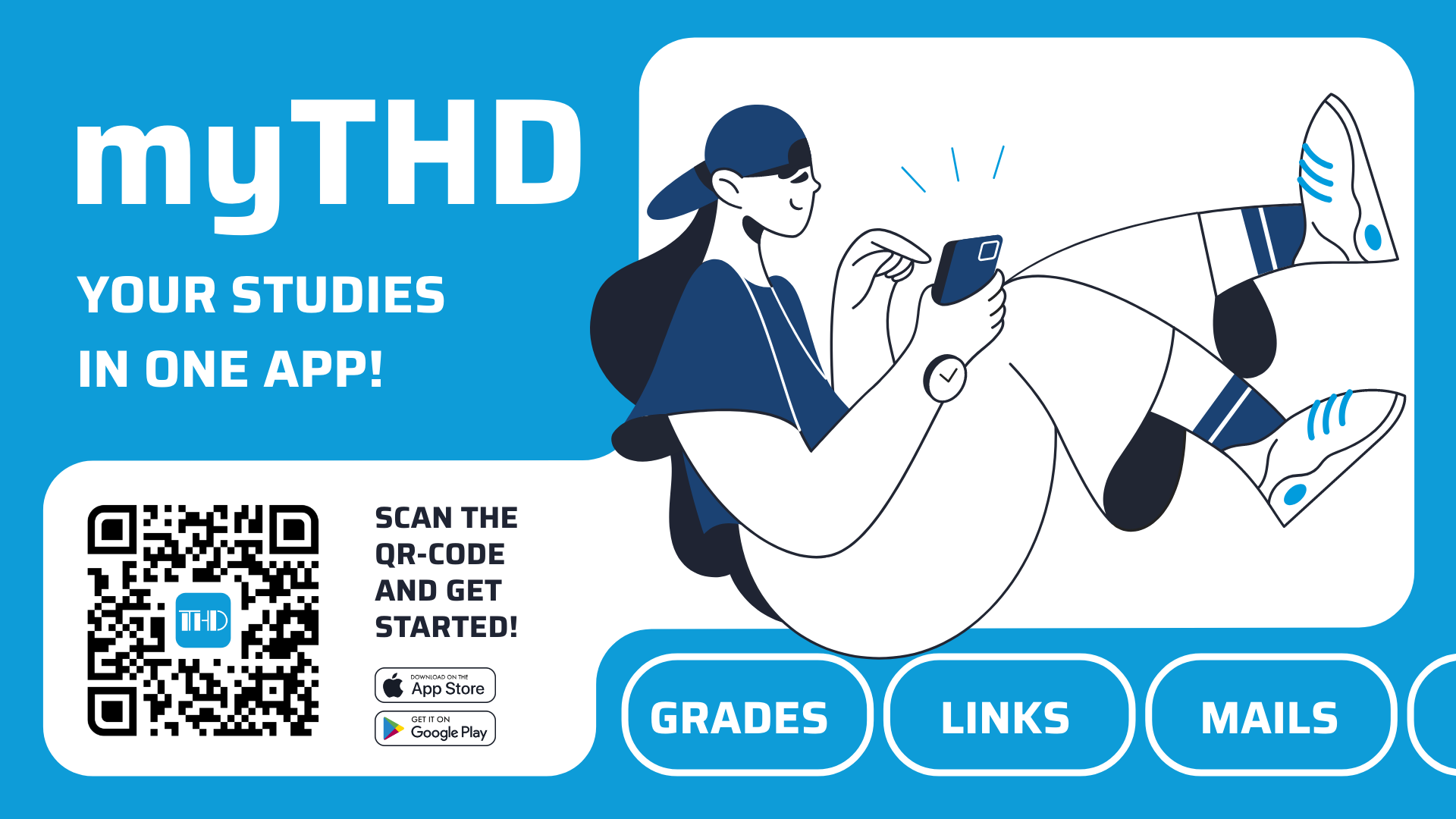
Our new university app myTHD is now available for download. 


Whether you're on the go, in a lecture, or at the cafeteria – the app offers you quick access to all important information about your studies and the university.

As a central platform, it combines numerous functions that make everyday student life easier and more organised:

  • Lecture schedules
  • Exam dates and grades
  • University emails
  • iLearn
  • Daily canteen menu
  • Internships & jobs via the career portal
  • Personal calendar
  • Newsfeed with updates, offers, and events at DIT


Download now and get started: 


quicklinks

organisation of your studies

Experience & Contribute to the Campus

career, jobs & financing

support and contact

after your studies


events


news

Pressefoto

News from the European Campus Rottal-Inn (ECRI) at the Deggendorf Institute of Technology (DIT). The first two graduates have completed the “Building Products and Processes” program. Bright prospects: While Johanna Einöder (22) works in quality management, Antony George Moonjelly (30) works as a construction manager.

Three and a half years ago, the practice-oriented bachelor’s program in international building product expertise launched in Pfarrkirchen. Now, the first two pioneers have passed their exams on digital construction processes and the development of internationally competitive building products. With their degrees, the successful graduates demonstrate their ability to contribute to the sustainable design of the buildings of the future.

Program director Prof. Dr. Markus Hainthaler expressed his pride at the presentation of the bachelor’s certificates, noting that “our graduates have quickly found permanent jobs.” Indeed, Johanna Einöder from Kastl near Altötting is working at the Lindner Group as a quality management specialist. Fittingly, the German student wrote her bachelor’s thesis on certifications. She found the internship semester particularly productive during her studies. “In Bremerhaven, I was able to combine theory with everyday life on a large construction site and saw why sustainability is important,” said Einöder.

Antony George Moonjelly (30) works as a site manager for the company Porr Industriebau in Passau, where he also lives. The Indian national had already completed his internship at this company – and proved himself. Among his main responsibilities today is ensuring that deadlines are met.

Pioneers of Sustainability

The creator of the program, Prof. Josef Steretzeder, emphasized that the curriculum for “Building Products and Processes” deliberately “views things through the lens of sustainability, the circular economy, and circularity.” There had previously been no program of this kind in the Bavarian higher education landscape.

Dean Prof. Dr. Steckenbauer said: “As the first two graduates, you are true pioneers. This degree is an important step in your careers.” As part of the English-language program, international students are taught intensive, practical German language skills. “These language skills must be at a level that enables students to work in local companies,” explained the dean.

Around 200 students graduate at ECRI every year

In total, the European Campus, one of the eight faculties at DIT, has already surpassed the 1,000-graduate mark in its eleven-year history. Prof. Dr. Steckenbauer describes the average length of study of 7.3 semesters as “a good average, especially since many students work alongside their studies.” All in all, around 200 students graduate each year from the campus in Pfarrkirchen, which has approximately 1,600 students. “And that’s truly impressive,” said the dean.

Pressefoto

Months of intensive preparation are behind them. Now it's time for exams at the European Campus Rottal-Inn (ECRI) of the Deggendorf Institute of Technology (DIT/THD). All 1,575 students are required to demonstrate their knowledge in a total of 235 exams in nine degree programs in accordance with their curricula. The exam period lasts three weeks until February 13.

“Please be quiet. Examination”

The exam period is in full swing. Signs in front of the lecture halls urge people to be quiet so as not to disturb the students. Behind the closed campus doors and in the city hall (Stadthalle), the examinees from five bachelor's and four master's degree programs are poring over the tasks set for them. They are being tested on their specialist knowledge in the overarching ECRI areas of tourism, health/digitalization, energy/technology, and sustainability/construction. Dean Prof. Christian Steckenbauer is keeping his fingers crossed for all graduates, but also says: “Our curricula are strict, the examinees are not being given anything for free.”

Since students take more than one exam, the ECRI study center has received up to ten registrations per capita in some cases. With 78 registrations, the bachelor's degree program in Industrial Engineering accounts for the largest single examination in “Principles in Business & Economics”.

Exams also in the city hall

The exams are not only held in the campus lecture halls. For space reasons, a number of exams are moved to the spacious city hall. This means that the tests do not have to be spread across several rooms. The following applies to all exams: The use of electronic devices such as cell phones is not permitted during the exam. For the first time, checks will be carried out to ensure that no artificial intelligence (AI) is used.

As always, the focus is on written exams. However, oral exams and the timely submission of research papers are also part of the requirements. “The exam requirements are strict,” confirms Birgit Espertshuber, head of department at the ECRI Study Center. According to her, repeated failure to meet deadlines will result in de-registration.

Grades announced in March

Mandatory retakes have already taken place, as have the compulsory language exams. Students and lecturers alike hope for the best possible results in all exams. The results will be announced starting March 2. For students in advanced semesters, bachelor's and master's theses are on the agenda in addition to exams.

The European Campus Rottal-Inn in Pfarrkirchen has been the international study location of the Deggendorf Institute of Technology for eleven years. Currently, students come from around 100 countries in Europe, Asia, Africa, and America. “In addition to technical training, there is a special focus on teaching German language skills,” says Prof. Dr. Steckenbauer.

Pressefoto

From November 10th to 20th, the International Office of Deggendorf Institute of Technology (DIT) transformed the campus into a gateway to the world. The Go Global Weeks offered students not only information, but also inspiration and the courage to take the step abroad. A variety of events provided opportunities to learn about exchange programs, internships, and countries, and to alleviate fears through personal experience reports.

Academic Advantage and New Opportunities 

The series was opened with "Ready for Abroad?", an event that gave an overview of the possibilities and advantages of a stay abroad. International experience is not only an academic advantage but also promotes independence and opens up new opportunities, including an international career start. For this purpose, the event "Five Steps to an International Internship" was held, which explained how to successfully start an internship abroad.

Focus on Europe with Erasmus+

A highlight of the first week was the Erasmus+ Day, which focused on the European area within the framework of the Erasmus+ program. An information session on financing, funding opportunities, and application processes was followed by a Meet & Greet with students who reported on their semesters abroad in Spain, Finland, Hungary, and even Aruba.

Global Perspectives and Intercultural Training

The second week broadened the view for global perspectives. The South Korea Workshop was particularly impressive, designed by two Korean exchange students who introduced their homeland, language, and university. This direct exchange conveyed a vivid picture of life in South Korea. This was complemented by an Intercultural Training that sensitized students to cultural differences and prepared them for international situations.

Special Guest from Australia and Experience Reports

The highlight of the second week was the "Go Global" Day. In addition to information on worldwide study options and funding opportunities, the University of the Sunshine Coast from Australia presented itself as a special guest. This day was also rounded off with experience reports from former exchange students about countries like Brazil, Canada, South Korea, and Hawaii.

Emotional and Interpersonal Dimension

The Go Global Weeks 2025 were thus far more than just information events. They conveyed not only facts but also the emotional and interpersonal dimension of a stay abroad. Overall, it was a successful impetus to overcome borders and broaden one's own horizons, both geographically and mentally.