What are BIPs?
Erasmus+ Blended Intensive Programmes (BIPs) are short, intensive study programmes that combine a physical mobility abroad with a compulsory virtual component. These programmes often include challenge-based learning, where transnational and transdisciplinary teams collaborate.
- Promote international cooperation
- Develop digital, intercultural, and professional competences
- Include learners who might otherwise not participate in long-term mobility programmes
- Reach students from diverse backgrounds, study fields, and education cycles
- At least three Erasmus+ partner universities from three different programme countries (DIT + 2 Erasmus partner universities) participate in planning and implementing the BIP: HEROES Universities will be prioritized. See list: https://www.th-deg.de/auslandsaufenthalte#partnerunis
- A minimum of 10 mobile learners take part in the on-site learning phase. (We recommend between 15 – 20 participants)
- Participants must earn at least 3 ECTS credits, which should be recognized by their home institution.
- The physical mobility should be at least 5 days and can be up to 30 days. The virtual part can be carried out before and/or after the physical part.
- Participants from universities in third countries may join but do not receive Erasmus+ funding and do not count towards minimum funding thresholds.
- Open to students at all levels as well as university staff.
- Participants receive Erasmus+ funding from their sending institution for the physical mobility phase, covering travel and living expenses.
- University staff involved in BIPs (as lecturers or organizers) may also be eligible for Erasmus+ funding.
- A "Green Travel" bonus may be granted for sustainable travel choices (e.g., train or bus instead of plane), offering slightly higher lump sums.
- DIT can be the organizer/coordinating university (BIP Incoming to DIT) or a partner sending out students and staff.
- As coordinating university there is Erasmus+ funding for excursions, cultural activities etc.
Incoming BIPs
- DIT sends the BIP´s invitation to partner universities (through the IO)
- Nomination by partner school (necessary to apply)
- Application at DIT through International Office via Mobility Online.
- Erasmus+ Documents arranged by International Office DIT (EWP).
- Accommodation arranged by International Office DIT.
- Cultural activities organized by International Office or faculty.
Outgoing BIPs
- DIT informs students/staff about BIPs organized by partner universities
- Students/Staff apply at the International Office of DIT
- IO DIT nominates students/staff
- Students/Staff apply at Partner university
- IO DIT arranges Erasmus+ funding for the physical mobility
If you are interested in participating or want to learn more about Erasmus+ BIPs, please contact: bip@th-deg.de

UpCOming Programmes
Previous programmes
- 11 and 28 September 2026 (virtual component)
- 14–18 September 2026, Deggendorf Institute of Technology (physical component)
Around 30 students and lecturers from various European universities took part in the international BIP ‘Intercultural Competences in International Business Settings’ at Deggendorf Institute of Technology. The programme combined online learning modules with a week of face-to-face sessions on the Deggendorf campus.
During the intensive week, the students explored topics such as:
- Intercultural communication
- Collaboration in multinational teams
- International leadership and negotiation strategies
- Conflict management in intercultural contexts
- Motivation and a culture of feedback in global teams
A particular highlight of the programme was the Week-Long Team Challenge. Working in multinational groups, the students developed market entry strategies for companies looking to expand into new international markets. In doing so, they analysed cultural differences, customer needs and the challenges of international teamwork.
A cultural programme, including an excursion to Dachau and Munich, complemented the academic content and fostered intercultural exchange.
The programme was organised by the Deggendorf Institute of Technology in collaboration with the following partner universities:
- Thomas More University of Applied Sciences (Belgium)
- Vaasa University of Applied Sciences (Finland)
- Kauno Kolegija (Lithuania)
In addition, students from other European universities took part:
- Łódź University of Technology (Poland)
- National University of Science and Technology Politehnica Bucharest (Romania)
- 16, 19 and 24 March, 21 April 2026 (virtual component)
- 13 April to 17 April 2026 (physical component in Feriendorf Finsterau)
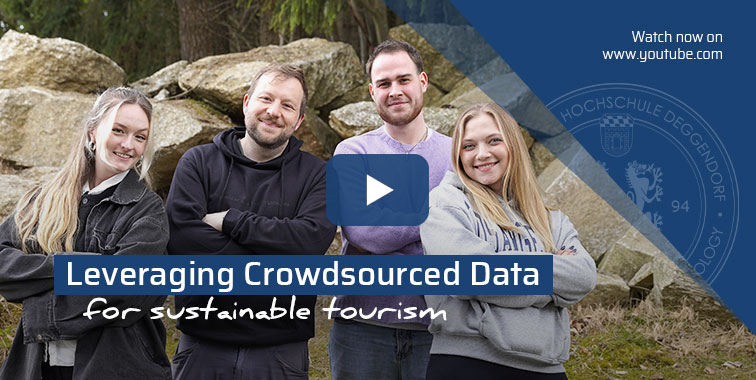
An international learning lab in the national park: the programme combines virtual preparatory sessions with a five-day in-person phase in the Bavarian Forest. The BIP follows an open-ended, challenge-based and design-thinking approach. Diverse and interdisciplinary student teams will collaboratively develop data-driven and ethically sound concepts for sustainable tourism management.
A total of 26 students from four HEROES partner universities gathered at the Feriendorf Finsterau to spend a week working on innovative solutions for sustainable tourism:
- Deggendorf Institute of Technology (Germany)
- Seinäjoki University of Applied Sciences (Finnland)
- Fontys University of Applied Sciences (Netherlands)
- Polytechnic Institute of Beja (Portugal)
The field trip to the national park was the highlight of the week. Under the guidance of Prof. Dr Florian Wahl and Dr Wilhelm, the teams gathered insights, carried out observations and analysed challenges relating to sustainability and visitor management.
Gain deeper insights into the
bleded intensive programme
Transforming Healthcare with AI:
Bridging Knowledge, Practical Applications, and Adoption
- 3-4 November (virtual component)
- 7-14 November (physical part in Pfarrkirchen)
Designed as an intensive, interdisciplinary learning experience that equips participants with the conceptual foundations, technical competencies, and critical perspectives needed to work effectively with artificial intelligence (AI) and machine learning (ML) in healthcare.
A total of 9 researchers and nearly 60 students from 13 partner universities participated, including
- Deggendorf Institute of Technology (Germany)
- University of Agder (UiA, Norway)
- Luleå Technical University (LTU, Sweden)
- Czech Technical University (CTU, Czechia)
The social program offered a wide range of opportunities for networking and informal exchange. It included a traditional Bavarian lunch, a Welcome dinner, a bowling evening, networking breakfasts, and an international coffee break. In addition, participants had the chance to further connect and experience the regional culture during a full-day excursion to Munich.
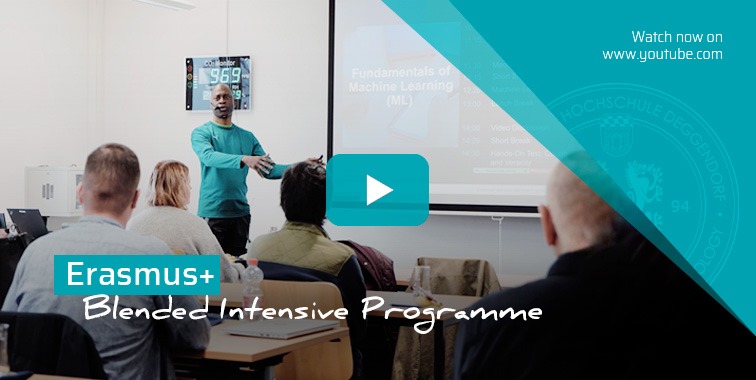
Insights into the BIP Transforming Healthcare with AI


